The Man Who Learned to Read at 47 — Then Built a Press That Published the Stories America Had Been Ignoring
The discharge papers came in a manila envelope. He remembered the weight of it, the official government seal, the feeling that this was a document that mattered. He carried it home on a bus, held it in his lap the entire ride, and when he finally opened it at his kitchen table, he stared at the words for a long time. Then he folded the papers carefully, put them back in the envelope, and slid the envelope under his mattress.
He had no idea what they said.
This was not an unusual situation for him. It was, in fact, the central fact of his adult life — a fact he had spent enormous energy concealing, rerouting around, disguising with charm and memory and a facility for conversation that most people mistook for confidence. He had survived the military, two tours, by listening harder than anyone else in the room. He had survived civilian life the same way. But the envelope under the mattress was a reminder that survival and literacy are not the same thing.
He was thirty-one years old when he came home. He would be forty-seven before he read a full page of text without help.
The Architecture of Hiding
Functional illiteracy in America is more common than most people realize, and far better hidden. An estimated 54 percent of American adults read below a sixth-grade level, according to literacy researchers — a number that sits quietly behind a culture that prizes education and treats reading difficulty as a personal failure rather than a systemic one.
For a Black veteran in a mid-sized Southern city in the 1970s and 1980s, the calculus around hiding was especially precise. He had grown up in a household where books were aspirational objects, present but rarely opened. The schools he attended were underfunded and overcrowded. He had slipped through without ever being caught, and the military had taken him on the strength of his physical fitness and his aptitude scores on the sections of the entrance exam that didn't require reading comprehension.
After discharge, he worked construction, then maintenance, then drove a delivery truck for eleven years — a job he'd gotten partly because he'd memorized the city's streets well enough that he didn't need to read the delivery manifests the way his coworkers did. He developed systems. He developed workarounds. He developed a way of moving through the world that kept the secret intact.
What he could not develop was a way of not knowing what he was missing.
A Library Card and a Stubbornness That Outlasted Everything
The library card belonged to his neighbor, a retired schoolteacher named Dolores who had figured out his secret about six months into their friendship and had not said a word about it for two years. When she finally did, she didn't make it a moment. She just handed him her card across the fence and said he should use it whenever he wanted.
 Photo: Dolores, via cdn.myseries.tv
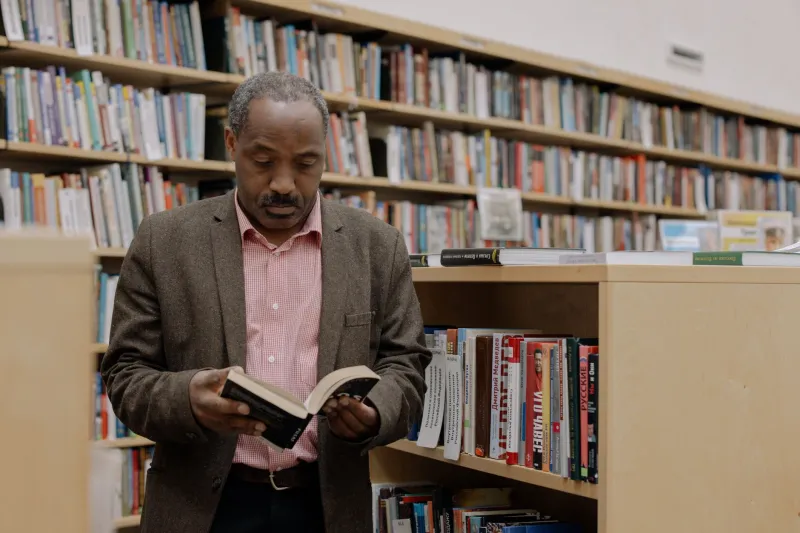
He started with children's books. He has talked about this publicly, without embarrassment, in the years since — the specific experience of sitting in the back corner of the public library at forty-seven years old, working through picture books and early readers, occasionally being greeted by children who assumed he was waiting for someone. He was not embarrassed, he said, because embarrassment requires caring what the room thinks of you, and by that point in his life he had stopped.
What he cared about was the reading.
It took two years of near-daily practice before he could read a newspaper article from start to finish without losing the thread. It took another year before reading felt less like decoding and more like understanding. He kept a notebook — first with Dolores's help, then alone — where he wrote down words he didn't recognize and looked them up. The notebook filled up. He started another one.
By the time he was fifty, he had read more books than most people read in a lifetime, with the focused intensity of someone who had been locked out of a room for decades and was now determined to see every corner of it.
What He Built with What He'd Learned
The publishing house started, like most unlikely institutions, as something much smaller. He had connected with a veterans' support group that was trying to collect personal stories from its members — oral histories, mostly, that would be transcribed and printed in a small pamphlet. He volunteered to help edit the transcriptions. Then to solicit more submissions. Then to figure out how to print and distribute the final product.
The pamphlet became a chapbook. The chapbook became an annual. And somewhere in that process, he realized that the stories being submitted — rough, unpolished, written by men and women who had never thought of themselves as writers — were better than almost anything he'd encountered in the mainstream literary journals he'd been reading his way through.
Not better in the sense of technically accomplished. Better in the sense of being true in a way that required no performance. These were people writing about their lives without the mediation of an MFA workshop or a publishing industry that had very specific ideas about which voices were worth amplifying.
He knew something about that particular experience.
The press he formally incorporated in the late 1990s operated on almost no budget for its first several years. He worked nights and weekends, used a photocopier at the library, sold copies out of his car at community events and veterans' gatherings. He was rejected by every distributor he approached. He was told, by people who meant to be helpful, that there was no market for what he was publishing.
The writers he published were told similar things, which was exactly why he kept publishing them.
The Longest Path to the Deepest Commitment
There is something particular about the relationship between a person and a skill they came to late and hard. It doesn't have the casualness of something learned young, when acquisition feels effortless and the stakes are low. It has weight to it. Every word he read in that library carried the memory of every word he'd pretended to read before.
That weight became the editorial philosophy of his press. He was not interested in writing that coasted on facility. He was interested in writing that had cost something — that bore the marks of a life lived without a safety net, without the luxury of treating language as decoration.
The press has now published hundreds of titles. Several of its authors have gone on to major commercial deals. A handful have won awards that the literary establishment hands out to writers it has decided to notice. None of that was the point. The point, as he has said in interviews with the patience of someone who has answered the question many times, was the same thing it was when he first sat down with a children's book in the back of a public library.
He just wanted to understand what the words said.
Everything else followed from that.