Lunch Break Genius: The Self-Taught Inventor Who Read His Way to Dozens of Patents
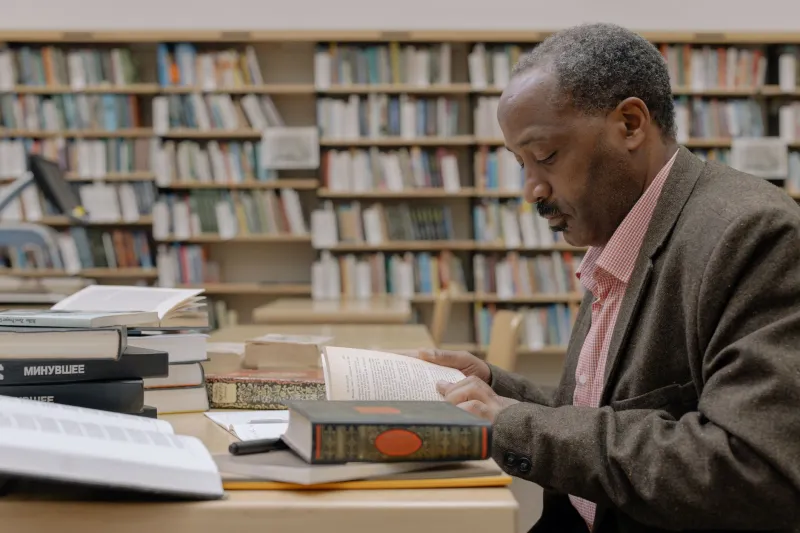
Elwood Pruitt arrived at the Dayton Public Library the same way every weekday — through the side entrance, brown bag in hand, work boots still dusty from the morning shift. He had forty-five minutes. He never wasted a single one.
 Photo: Dayton Public Library, via www.sinclairclarion.com
For most of his adult life, Pruitt worked as a custodian at a manufacturing plant in Ohio. He swept floors, emptied trash cans, and scrubbed bathrooms in a building full of engineers who had never once learned his last name. But between noon and 12:45, five days a week, Elwood Pruitt became something else entirely. He became a student — systematic, obsessive, and entirely self-directed.
By the time he filed his first patent in 1961, he had worked his way through nearly the entire science and technology section of that library. By the time he filed his thirty-second, the patent examiners in Washington had no idea that the name on the applications belonged to a man who had never set foot inside a college classroom.
The Library as a University
Pruitt grew up in rural Tennessee in the 1920s, the son of a sharecropper who could not afford to keep his children in school past the eighth grade. He was, by every institutional measure, a poor candidate for an intellectual life. The system had already written its verdict before he was old enough to appeal it.
But Pruitt had a quality that formal education sometimes smothers rather than nurtures: an almost pathological curiosity. When he moved north to Dayton after World War II — part of the Great Migration's industrial wave — he found steady work but restless evenings. He started visiting the library casually, the way a man might stop into a diner. Then it became deliberate. Then it became a discipline.
He kept handwritten notebooks cataloging what he read, organized by subject. Chemistry led to materials science. Materials science led to mechanical engineering. Engineering led to fluid dynamics. He cross-referenced concepts across books the way a scholar might, except his footnotes were scrawled in the margins of composition notebooks bought at the five-and-dime.
"He didn't read the way most people read," his daughter, Carolyn Pruitt Watkins, recalled in a 1998 oral history recorded by the Ohio Historical Society. "He read like he was building something. Every book was a piece of a structure he had in his head."
The First Patent and the System That Almost Stopped Him
In 1959, Pruitt noticed a recurring problem at the plant where he worked. A specific type of industrial valve — used in the facility's coolant system — had a tendency to develop micro-fractures along its seam under sustained thermal pressure. Engineers would replace it. It would crack again. The cycle was expensive and nobody seemed particularly motivated to fix it.
Pruitt had been reading metallurgy for three years by then. He had also, without anyone asking him to, been quietly observing the valve's failure patterns for months. He sketched a modified design in one of his notebooks — a small alteration to the seam geometry that would distribute thermal stress more evenly. He showed it to his supervisor, who showed it to an engineer, who told him it was an interesting idea and then did nothing with it.
So Pruitt filed the patent himself.
Navigating the U.S. patent system in 1961 as a Black man with an eighth-grade diploma and no institutional backing was not a casual undertaking. The paperwork alone was designed to intimidate. Pruitt spent four months reading patent law at the library, studying previously approved filings to understand the language and structure the examiners expected. He wrote his application in precise, technical prose that gave no indication of who he was or where he worked.
It was approved in 1962.
An Invisible Empire of Ideas
What followed over the next three decades was one of the quietest innovation careers in American industrial history. Pruitt filed patents covering improvements to valve mechanisms, heat exchange systems, pipe insulation design, and — in a late-career pivot that surprised even his family — a novel approach to ergonomic handle design for industrial cleaning equipment. That last one was, his daughter suspected, a small private joke.
Not every application succeeded. He estimated he filed close to fifty over his lifetime and received approval on thirty-two. Some were purchased by manufacturers outright. Others he licensed for modest fees. None made him wealthy in any dramatic sense, but they supplemented his income steadily and, more importantly, they existed. They were real. They were his.
What's striking about Pruitt's story isn't just the inventions themselves — it's the system he had to outmaneuver to make them count. The patent office, whatever its faults, evaluated applications on their technical merits. It didn't ask where you went to school. It didn't ask what you did for a living. In that narrow window of pure meritocracy, Pruitt found his opening and walked straight through it.
What We Lose When We Build Walls Around Genius
Pruitt retired from the plant in 1984. He kept visiting the library until his eyesight made it difficult in the mid-1990s. He died in 2003 at the age of 79, and his obituary in the Dayton Daily News ran four sentences.
His story raises an uncomfortable question, one that doesn't get asked loudly enough: How many Elwood Pruitts didn't make it through?
The patent system gave him a crack in the door, but most institutional gatekeepers aren't that indifferent to credentials. Medical research, academic publishing, corporate R&D — these are worlds built on letterhead and pedigree. The people inside them are not malicious, usually. They're just accustomed to a certain kind of genius. The kind that arrives with documentation.
Pruitt's genius arrived in a brown bag, forty-five minutes at a time, in a library that belonged to everyone and therefore, quietly, to him.
His daughter still has the notebooks. Seventy-three of them, filled from cover to cover in her father's careful handwriting — a private university that one man built and attended alone, year after year, in the margins of a working life the world assumed was ordinary.
It was anything but.