The Cartographer Who Never Left Home: How One Woman Mapped America from Her Kitchen
The Map Maker Who Never Traveled
In 1903, while Teddy Roosevelt was urging Americans to embrace the "strenuous life" of outdoor adventure, a sickly eight-year-old girl in rural Wisconsin was discovering that the greatest journeys could happen without ever leaving your chair.
Marie Tharp would spend the next six decades proving that point, creating some of the most accurate and influential maps of American wilderness from the confines of her family's farmhouse kitchen. Her story challenges everything we think we know about exploration, expertise, and the boundaries of human curiosity.
 Photo: Marie Tharp, via as1.ftcdn.net
A Different Kind of Pioneer
Marie was born into a family of modest means in a time when ambitious young women had few outlets for their intellect. Her father worked as a county surveyor, but chronic respiratory illness kept Marie housebound for months at a time. While other children played outside, she spent her days studying her father's maps and survey notes, fascinated by the way lines on paper could represent vast landscapes.
What started as a way to pass sick days became an obsession. Marie taught herself to read topographical surveys, geological reports, and land office records. She corresponded with travelers, miners, and government surveyors, collecting firsthand accounts of terrain that existed only in her imagination.
"I could see the mountains in my mind," she wrote years later. "I knew their slopes and valleys better than the people who walked them, because I had studied every inch on paper."
The Correspondence Network
By her twenties, Marie had built an extraordinary network of correspondents across the American West. Railroad surveyors, military expedition leaders, territorial governors, and frontier newspaper editors all knew her name. They sent her sketches, measurements, and detailed descriptions of geographical features that had never been properly mapped.
Marie synthesized this information with an almost supernatural ability to visualize terrain. She could take a dozen conflicting accounts of a mountain range and produce maps that were more accurate than official government surveys. Her kitchen table became mission control for an informal but incredibly effective geographical intelligence network.
When the U.S. Geological Survey was established in 1879, several of its founding members were already familiar with Marie's work. They quietly consulted her maps and incorporated her corrections into official publications, though her name rarely appeared in the credits.
The Art of Invisible Expertise
Marie's gender and unconventional methods meant her contributions were often uncredited, but her influence was undeniable. Prospectors used her maps to find mineral deposits. Railroad companies relied on her terrain analysis to plan routes. Military commanders consulted her work before moving troops through unfamiliar territory.
Her maps were distinguished by an attention to detail that professional surveyors couldn't match. While government cartographers focused on broad features, Marie noted seasonal water sources, game trails, natural shelters, and other details that could mean the difference between life and death for travelers.
"She understood that a map isn't just about where things are," explained one contemporary. "It's about how people move through space, what they need to survive, what obstacles they'll face. Marie mapped the land as if she cared about the people who would use her work."
The Great Western Survey
Marie's most ambitious project began in 1885, when she decided to create a comprehensive atlas of the American West. Working entirely from her kitchen in Wisconsin, she spent fifteen years compiling the most detailed maps of Western territories that had ever been attempted.
The project required her to coordinate information from hundreds of sources. She developed her own system of notation to track conflicting reports and used statistical methods to determine the most likely accurate measurements. When she encountered gaps in the available data, she would write to local postmasters, asking them to take specific measurements or confirm geographical details.
The resulting atlas contained 147 hand-drawn maps covering everything from major river systems to individual mining camps. It became an unofficial but essential reference for anyone traveling west of the Mississippi.
Recognition at Last
Marie's breakthrough into official recognition came in 1902, when a government expedition to map the Colorado River ran into serious trouble. Their official maps were so inaccurate that the team became lost in terrain they thought they knew. A telegraph to Washington brought a surprising response: consult Marie Tharp's maps.
 Photo: Colorado River, via i.ytimg.com
Using Marie's detailed charts of the Colorado River system, the expedition was able to complete its mission successfully. The team leader, Major John Wesley Powell Jr., publicly credited Marie's work and recommended that the government formally acknowledge her contributions to American cartography.
Suddenly, the woman who had never traveled beyond her home county was being consulted on matters of national importance. Government agencies began officially commissioning her work, and her maps were finally published with proper attribution.
The Science of Staying Put
Marie's story reveals something profound about the nature of expertise and exploration. While her male contemporaries gained credibility through physical presence in the territories they mapped, Marie developed a different kind of authority — one based on synthesis, analysis, and an almost mystical ability to see patterns in data.
Her methods were surprisingly modern. She used what we would now call crowdsourcing to gather information, applied statistical analysis to resolve conflicting reports, and created feedback loops to continuously improve her maps' accuracy. Most importantly, she understood that good cartography required not just geographical knowledge but deep empathy for the people who would use her work.
"Marie proved that you don't have to go somewhere to understand it," noted a 1950s retrospective on her career. "Sometimes the view from a distance is clearer than the view from the ground."
Legacy of the Kitchen Table Cartographer
Marie continued mapping until her death in 1924, producing over 300 detailed charts of American wilderness areas. Many of her maps remained in use well into the 20th century, and some of her geographical insights weren't confirmed by modern satellite imagery until the 1960s.
Her story challenges our assumptions about expertise, adventure, and the boundaries of human curiosity. In an age that celebrated physical courage and masculine exploration, Marie proved that the greatest discoveries sometimes come from staying still and thinking deeply.
Today, when GPS technology can pinpoint our location anywhere on Earth, it's easy to forget how recently vast parts of America were unmapped territory. Marie Tharp spent her life making the unknown knowable, one hand-drawn line at a time, proving that the most important journeys aren't always the ones we take with our feet.
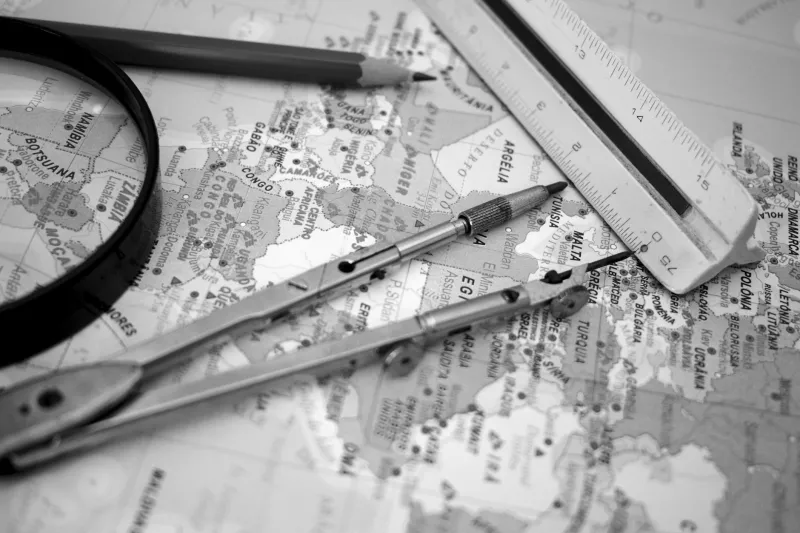
Her kitchen table, preserved at the Wisconsin Historical Society, still holds the tools she used to map a continent: rulers, compasses, and stacks of correspondence from a thousand travelers who trusted a woman they'd never met to help them find their way home.
 Photo: Wisconsin Historical Society, via webshop.schachermayer.com