What the Bees Knew: The Backyard Beekeeper Who Cracked a Medical Mystery the Experts Had Missed
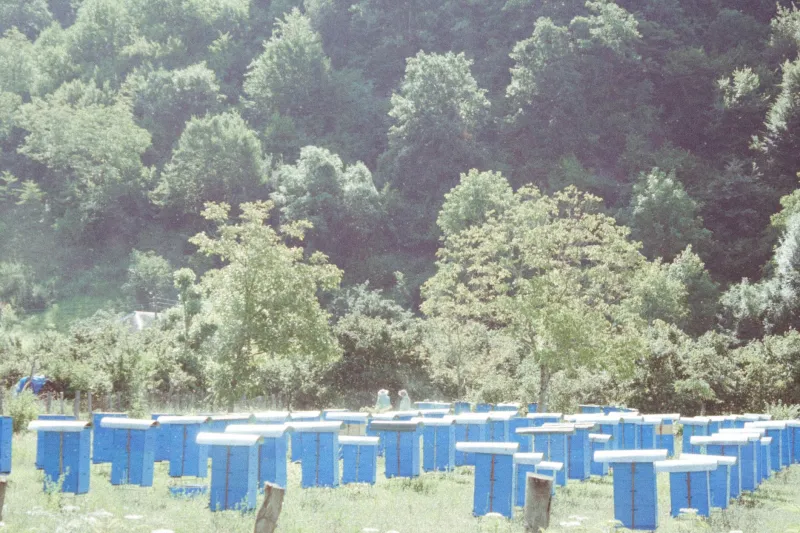
Before Calvin Marsh became a footnote in a peer-reviewed journal — and then, eventually, a full paragraph — he was just a beekeeper in Breathitt County, Kentucky, with a notebook full of observations nobody had asked for.
Calvin had grown up working his family's hives in the hills east of Jackson, learning the rhythms of the land the way rural kids learn things: through proximity and repetition, not instruction. His father kept bees. His grandfather had before that. By the time Calvin was running the operation himself in the late 1970s, he had absorbed decades of accumulated knowledge about the land, the seasons, and the people who lived alongside both.
It was that last category — the people — where things started to get interesting.
A Pattern in the Hollow
Calvin's hives were spread across several miles of creek bottomland and hillside, which meant he spent a lot of time moving through the community — stopping at neighbors' properties, talking to families, watching the same households across years and decades. He was, without intending to be, conducting a kind of informal longitudinal study.
What he noticed, slowly and without any particular framework for interpreting it, was a clustering of certain health problems in specific pockets of the county. Families along one stretch of creek seemed to run heavy with thyroid trouble. A cluster of households near an old industrial site — a site that had been formally cleared and closed — showed rates of respiratory illness that struck Calvin as too consistent to be coincidence. He wasn't counting cases or running statistics. He was just noticing, the way a man who pays attention notices things.
He started writing it down in 1983. Not in any scientific format — just dates, names (first names only, out of courtesy), and observations. He filled one composition notebook, then another.
He showed his notes to a county health worker at a fair in 1986. She was polite. She said she'd pass them along. Nothing happened.
The Accidental Researcher
What Calvin didn't know — couldn't have known — was that his observations were touching the edge of a genuine scientific puzzle. The relationship between low-level industrial contamination and diffuse, hard-to-attribute health outcomes was a contested and underfunded area of research in the 1980s. The clusters he was describing informally were the kind of thing epidemiologists dreamed of finding clean data on.
His data was not clean. It was handwritten in a spiral notebook by a man who spelled "respiratory" three different ways across the same entry.
But it was there, accumulated over years, rooted in a community that researchers rarely had access to and couldn't easily replicate. Calvin knew these families. He knew their histories, their land, their water sources. He had watched the same people across two and three decades. That kind of longitudinal proximity is almost impossible to manufacture in a formal study.
The connection finally happened through a University of Kentucky graduate student named Patricia Odom, who was doing field interviews in Breathitt County for a public health thesis in 1991. A county official, half-jokingly, mentioned that there was a beekeeper who'd been keeping his own health records for years. Odom tracked Calvin down.
She spent an afternoon at his kitchen table. She came back the next day. Then she called her thesis advisor.
When Folk Knowledge Meets the Scientific Method
What followed was neither quick nor smooth. Calvin's notebooks became the basis for a more formal investigation, but the process of translating lived observation into publishable data was slow and sometimes frustrating for everyone involved. Researchers had to verify what Calvin had recorded, establish proper controls, and account for variables he hadn't tracked. Some of what he'd observed didn't hold up under scrutiny. Some of it held up remarkably well.
A 1997 paper in a regional environmental health journal — co-authored by Odom and two faculty researchers, with Calvin listed in the acknowledgments — documented a statistically significant cluster of thyroid abnormalities in the creek bottomland households Calvin had flagged more than a decade earlier. The probable cause traced back to legacy contamination from an industrial operation that had been considered fully remediated.
Calvin was not listed as a co-author. He said he didn't want to be. "I'm not a doctor," he told a local newspaper that ran a small piece on the study. "I just paid attention."
That quote ran under a photo of him in his bee gear, smoker in hand, looking mildly annoyed at the camera.
What the Experts Had Missed
The uncomfortable truth embedded in Calvin's story is that the medical and environmental research establishment had the tools to find what he found — and didn't. The county had been surveyed. The site had been assessed. The remediation had been certified. The boxes had been checked.
What the process lacked was the slow, unglamorous, decades-long act of watching. Calvin wasn't smarter than the researchers who'd come through Breathitt County. He was simply present in a way they couldn't be. His knowledge was structural — built into how he moved through the landscape, who he talked to, what he noticed because he'd been noticing it for forty years.
There's a word for this kind of knowledge in academic circles now: it gets called "community-based participatory research" or "local ecological knowledge," and there's a growing body of literature arguing that formal science ignores it at its own peril. Calvin Marsh had never heard either phrase. He just kept his bees and wrote things down.
He died in 2011 at age seventy-eight. His notebooks are held by a family member in Jackson. The creek bottomland he spent his life walking still runs through the hills east of town.
The bees are still there too.