The Hewlett-Packard Garage That Started Silicon Valley
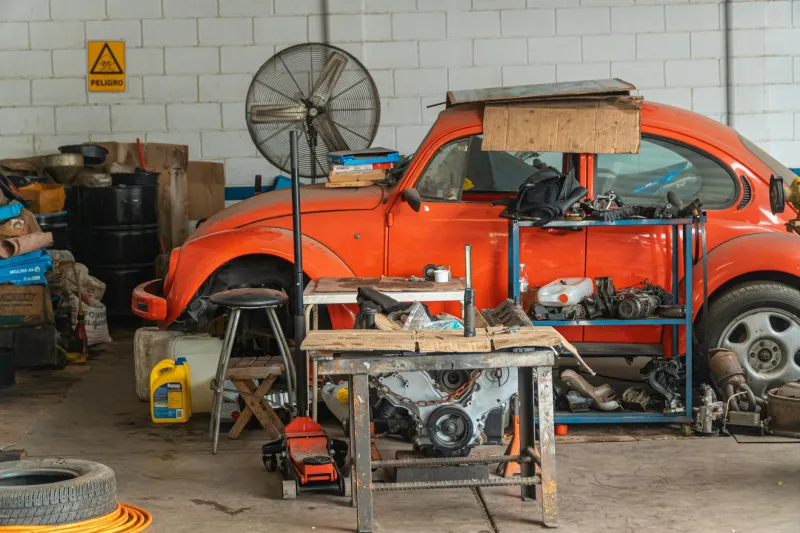
In 1938, two Stanford graduates named Bill Hewlett and Dave Packard rented a small house in Palo Alto for $45 a month. The real workspace wasn't inside—it was the cramped, one-car garage behind the house. With $538 in startup capital and a collection of used equipment, they began tinkering with audio oscillators.
 Photo: Palo Alto, via i0.wp.com
Their first major breakthrough came when Walt Disney Studios ordered eight of their Model 200B oscillators to help design the sound system for "Fantasia." That garage, now designated as the birthplace of Silicon Valley, proved that revolutionary technology doesn't require revolutionary facilities—just revolutionary thinking.
Steve Wozniak's Bedroom Laboratory
While everyone knows about Apple's garage origins, the real magic happened in Steve Wozniak's childhood bedroom in Los Altos, California. Throughout the early 1970s, Wozniak spent countless nights hunched over a cluttered desk, surrounded by circuit boards and technical manuals, designing what would become the Apple I computer.
His parents' house became an unlikely research and development center. The dining room table served as an assembly line, the kitchen hosted late-night brainstorming sessions, and that cramped bedroom witnessed the birth of personal computing. When the Apple I debuted in 1976, it had been conceived entirely in domestic spaces that bore no resemblance to a traditional laboratory.
Art Fry's Church Hymnal Problem
In 1974, 3M scientist Art Fry was getting frustrated during choir practice at his Presbyterian church in North St. Paul, Minnesota. His bookmarks kept falling out of his hymnal at the worst possible moments. That weekend, in his home basement workshop, Fry remembered a "failed" adhesive his colleague Spencer Silver had developed—a glue that stuck lightly but could be easily removed.
Using his kitchen table as a laboratory, Fry began experimenting with Silver's weak adhesive on small pieces of paper. After months of basement tinkering, he created the first Post-it Notes. What started as a church choir annoyance became a billion-dollar product that revolutionized office communication worldwide.
Chester Carlson's Kitchen Chemistry
In 1938, patent attorney Chester Carlson was tired of hand-copying legal documents. In the kitchen of his Queens apartment, he began experimenting with static electricity and light-sensitive powders. His wife was less than thrilled when their kitchen became a chemistry lab, complete with sulfur powders and makeshift equipment.
On October 22, 1938, Carlson successfully created the first xerographic image in that cramped kitchen, copying the words "10-22-38 Astoria" onto a piece of paper. It took him nearly a decade to find a company willing to develop his invention, but that kitchen experiment eventually became Xerox Corporation and transformed how the world handles documents.
Tim Berners-Lee's CERN Office Corner
While working at CERN in Switzerland in 1989, British computer scientist Tim Berners-Lee didn't have access to a fancy laboratory. Instead, he worked from a cluttered corner office, using a NeXT computer to develop a "web" of interconnected documents.
His goal was simple: help CERN scientists share information more easily. Working alone in that small office space, Berners-Lee wrote the code that became the World Wide Web. He deliberately chose not to patent his invention, believing the web should be free for everyone. That corner office decision changed how humanity communicates, learns, and connects.
Ruth Wakefield's Toll House Kitchen
In 1938, Ruth Wakefield was experimenting in the kitchen of her Toll House Inn in Whitman, Massachusetts. She was making butter cookies for her guests but ran out of baker's chocolate. Improvising, she broke up a bar of Nestlé semi-sweet chocolate, expecting it to melt evenly through the dough.
Instead, the chocolate pieces held their shape, creating something entirely new. Her accidental invention—the chocolate chip cookie—became America's most popular cookie. Nestlé eventually bought her recipe for a lifetime supply of chocolate, and that inn kitchen experiment became a global phenomenon worth billions.
Philo Farnsworth's Idaho Potato Field Vision
In 1921, fourteen-year-old Philo Farnsworth was plowing his family's potato field in Rigby, Idaho, when inspiration struck. Looking at the parallel furrows he'd created, he envisioned scanning images line by line to transmit them electronically.
Six years later, in a cramped San Francisco laboratory funded by a group of investors, Farnsworth successfully transmitted the first electronic television image. The boy who'd had his eureka moment in an Idaho potato field had invented television at age 21, working in a space barely larger than a garage.
Josephine Cochrane's Shed Workshop
In 1886, socialite Josephine Cochrane was tired of her servants breaking her fine china while washing dishes. In a shed behind her Illinois mansion, she began designing a machine that could clean dishes without damaging them.
Working with minimal tools and no engineering background, Cochrane created the first practical dishwasher. She measured her dishes carefully, designed wire compartments to hold them securely, and developed a system of rotating spray arms. When she couldn't find a manufacturer willing to produce her invention, she started her own company. That shed workshop eventually became KitchenAid Corporation.
Jack Kilby's Texas Instruments Back Room
In the summer of 1958, Jack Kilby was the only engineer left at Texas Instruments during the company vacation shutdown. Working alone in a cluttered back room, he had an idea that would revolutionize electronics: putting multiple electronic components on a single piece of semiconductor material.
With basic tools and limited materials, Kilby built the first integrated circuit—essentially the first computer chip. His crude prototype, assembled in that quiet back room, launched the digital revolution and made modern computers, smartphones, and virtually all electronic devices possible.
Edwin Land's Hotel Room Darkroom
In 1943, while on vacation in Santa Fe, New Mexico, Edwin Land's three-year-old daughter asked why she couldn't see the photo he'd just taken of her immediately. That night, in his hotel room, Land began sketching ideas for instant photography.
Returning to his Polaroid laboratory in Cambridge, Massachusetts, Land worked obsessively in a converted garage space, developing the chemistry and mechanics needed for instant film. His hotel room inspiration, refined in that garage laboratory, resulted in the Polaroid camera—a technology that dominated photography for decades.
The Common Thread
These ten inventions share more than humble origins—they represent a uniquely American belief that innovation doesn't require permission, credentials, or fancy facilities. Each inventor worked with whatever space and resources they had available, driven by curiosity rather than capital.
Their stories remind us that the next world-changing invention might be happening right now in someone's basement, spare room, or garage. In America, revolutionary ideas don't wait for perfect conditions—they make the most of whatever conditions they find.